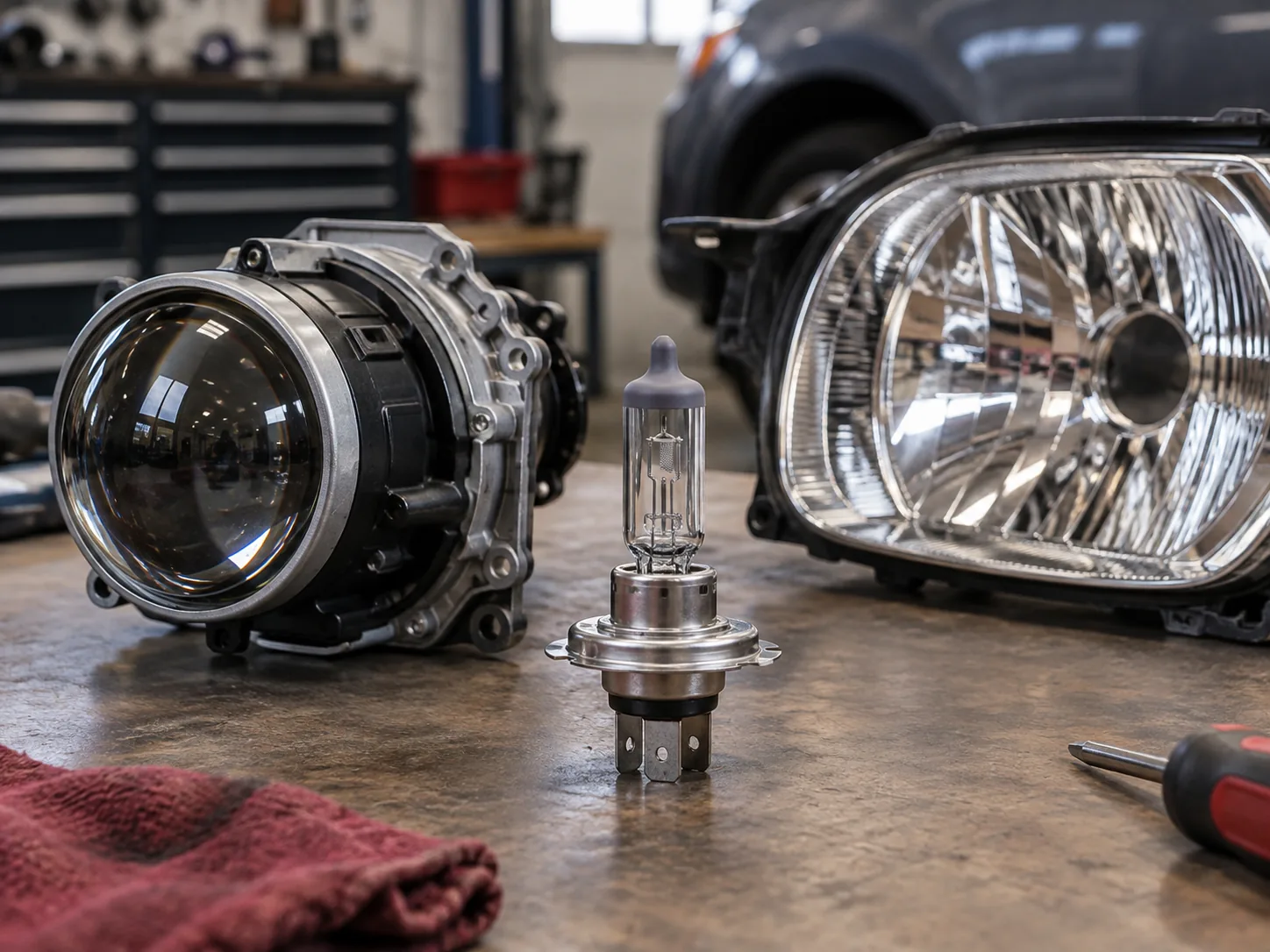

Replacing a 9007 headlight bulb is straightforward only after you confirm the bulb is actually the right one for your vehicle. Model year alone is not enough: trim changes, replacement headlamp assemblies, and previous repairs can change what is installed. Use the checks below before ordering, especially if you are considering an LED retrofit.
First, confirm the bulb your car uses
9007, also called HB5, is a dual-beam bulb family: one bulb provides both low and high beam through separate filaments. That describes the bulb type, not a universal fitment list. It does not prove that a particular year, make, model, trim, or replacement headlamp takes 9007.
- Look up the low/high-beam bulb in the owner’s manual or the vehicle maker’s service information for your exact year, make, model, and trim.
- If you can safely access the installed bulb, read the code printed or molded on its base. Do not rely on a retailer’s broad “fits” list alone.
- Compare the base and connector with the replacement listing. If the manual and installed bulb disagree, or the headlamp assembly has been replaced, identify the assembly and resolve the mismatch before buying.
A bulb finder is a useful cross-check, not a substitute for the vehicle manual or the code on the installed part. For example, use the Sylvania automotive bulb finder and confirm its result independently.
9007 vs. 9004, 9005, and H13
| Code | General configuration | What to do |
|---|---|---|
| 9007 / HB5 | Dual-beam bulb family | Use only when the vehicle information and installed bulb confirm it. |
| 9004 / HB1 | Different dual-beam bulb family | Do not treat it as interchangeable with 9007 based on appearance. |
| 9005 / HB3 and 9006 / HB4 | Separate single-beam bulb families | They are not substitutes for a 9007 dual-beam bulb. |
| H13 / 9008 | Another dual-beam family with a different base | Verify the actual code; “dual beam” does not mean same fitment. |
These names identify bulb families, not guaranteed vehicle applications. Never file, force, or modify a base or connector to make a bulb fit. If the code is unreadable and the housing has no reliable label, ask a parts professional or repair shop to identify it.
Choose the replacement type
Halogen replacement: Usually the most direct choice when the vehicle was designed for a replaceable halogen 9007 bulb. Match the specified bulb type and any requirements in the manual; avoid assuming that a higher-wattage bulb is a safe upgrade.
LED replacement bulb: Check more than the socket. Confirm physical clearance behind the housing, including the dust cap; whether a fan or driver fits; whether the maker lists your specific housing/application; and what the return policy covers if it does not fit or produces a poor beam. A bulb that plugs in can still be unsuitable optically or legally.
In the United States, NHTSA’s February 2024 interpretation explains that, under the federal lighting standard discussed in its letter, replaceable LED light sources were not permitted in headlamps designed for replaceable bulbs. That letter is not a universal answer for every jurisdiction or a substitute for current legal advice. Check current federal and state requirements before using an LED retrofit on public roads. See NHTSA’s interpretation on LED headlight replacements.
Before you order: a fitment checklist
- Bulb code: the manual/service information and installed bulb identify 9007/HB5.
- Position: you are buying for the correct low/high-beam position, not a fog lamp or another light.
- Connector: the plug and retaining method match; no adapter or forced modification is required unless the vehicle maker specifies it.
- Space: the bulb body, heat sink, fan, and driver (if any) clear the housing and allow the dust cap or seal to close as designed.
- Condition: the socket and wiring are not burned, melted, corroded, or loose. Repair damaged wiring before installing a new bulb.
- Rules and returns: check local requirements and the seller’s vehicle-fitment and return terms before opening or modifying parts.
After installation
Follow the vehicle and bulb maker’s instructions; disconnect power only as the vehicle manual directs. Avoid touching halogen glass with bare fingers. Seat the bulb fully, secure its retainer, reconnect the plug, and reinstall the dust cap or seal. Test both low and high beams, then check that the beam pattern is even and the housing is closed.
Do not use a generic wall distance or adjustment measurement as a universal specification. Use the aiming method and target for your vehicle from its service information. If the beam is scattered, the connector heats up, a fuse repeatedly blows, a warning appears, or the housing will not seal, stop and diagnose the cause rather than continuing to drive with a questionable light.
Common questions
Is 9007 the same as HB5? Yes. HB5 is another designation used for the 9007 bulb family. Still verify the installed bulb and vehicle application.
Can I use a 9004 or 9005 instead? No. They identify different bulb families and are not drop-in substitutes for a confirmed 9007 application.
Does 9007 mean the bulb fits my vehicle? No. It tells you the bulb family. Your exact vehicle configuration and headlamp assembly determine fitment.
Can I replace a 9007 halogen with LED? A physical connector match does not establish beam performance or road legality. Check the current rules where you drive and the requirements for the specific headlamp before deciding.
Compare only after confirming fitment
If your manual and installed bulb both confirm 9007/HB5, you have checked the housing clearance and applicable rules, you can compare current AUXITO 9007 LED listings. The collection page is a product list, not a vehicle-fitment or legal-approval tool. Verify each listing’s current details and return terms before buying.
Affiliate disclosure: ModernCarGear may earn a commission if you buy through this link, at no extra cost to you.
Sources
- NHTSA interpretation, replaceable LED headlight sources (the federal-standard statement above is specifically attributed to this dated letter).
- Sylvania Automotive bulb finder (a secondary fitment cross-check; confirm against vehicle information and the installed bulb).