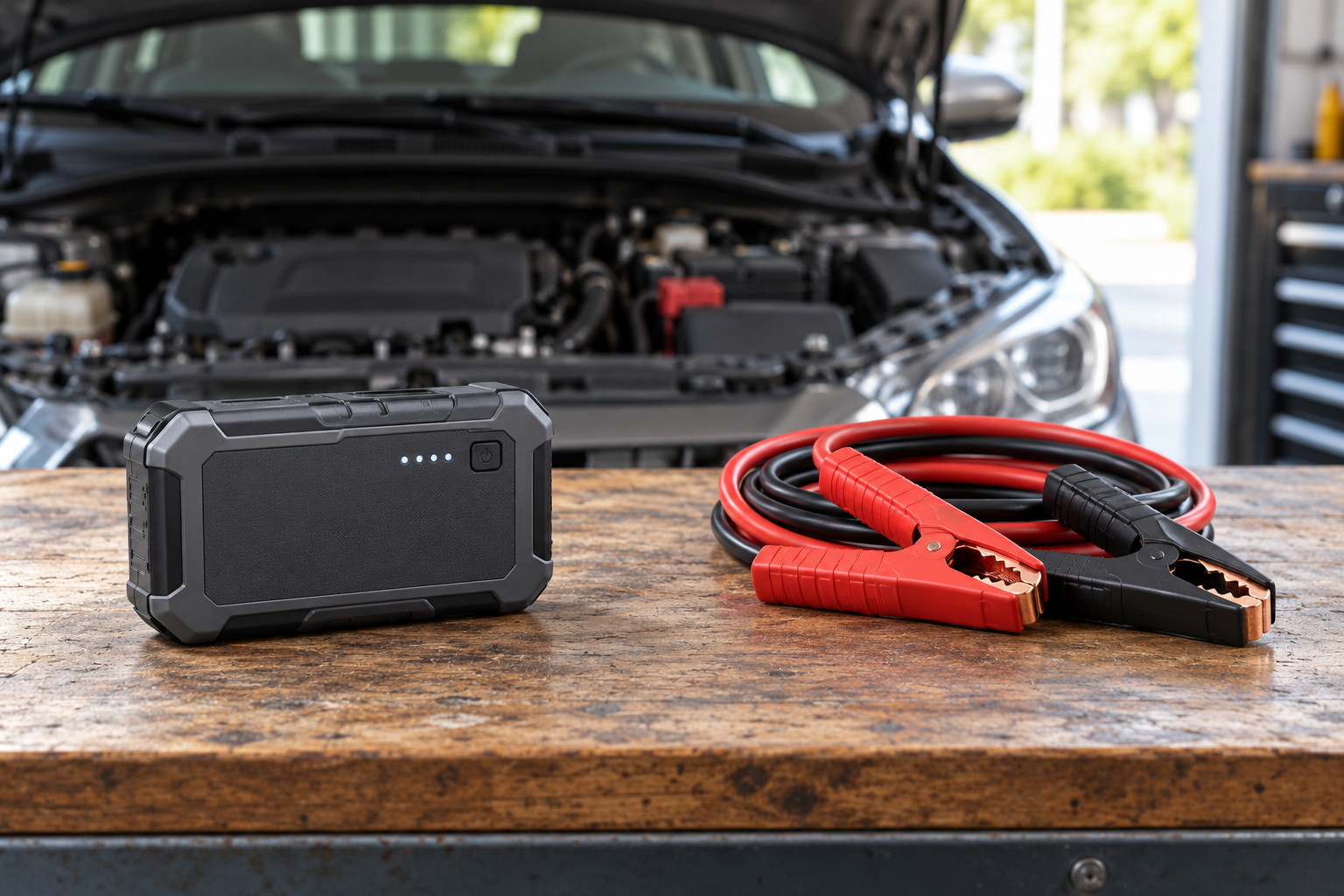

Quick answer: keep a portable jump starter if you often drive alone or cannot count on another vehicle being nearby. Jumper cables make sense when you reliably have a compatible donor vehicle and know how to follow both vehicles’ instructions. If you travel remotely, either tool can fail on its own; carrying both is a redundancy choice, not a requirement for every driver.
This is a research-based comparison, not a hands-on test. Neither option repairs a failed battery, starter, charging system or damaged wiring. Find more practical equipment decision guides in our Car Accessories hub.
Choose by the situation you need to solve
- You park alone or travel solo: a charged, correctly rated portable pack removes the need to find a donor car. It only helps if its rating matches your vehicle and you maintain it as its manual directs.
- You usually have another suitable vehicle at home: cables may be a lower-cost backup, but confirm the donor vehicle is approved for jump-starting the other vehicle. Some manuals restrict or prohibit using a vehicle as a donor.
- You drive a diesel, larger engine, or a vehicle with a special battery setup: do not choose by a generic amp chart. Verify the pack’s exact engine/fuel rating and the vehicle’s jump-start procedure; if either is unclear, keep roadside assistance as the plan.
- You need a backup for remote trips or work: carrying both can provide options, but neither replaces a charged battery, a safe stopping place, or roadside help.
What actually differs?
Portable jump starter
What it solves: a no-start caused by a weak 12-volt battery when no donor vehicle is available, provided the vehicle and pack are compatible and the battery is safe to boost.
Trade-off: it is another battery-powered device to charge, store, inspect and keep within its stated temperature limits. A low charge, unsuitable rating, damaged pack or wrong connection point can make it ineffective or unsafe.
Check before buying: vehicle voltage and battery type; the exact model’s gas/diesel engine coverage; instructions for start-stop or auxiliary-battery vehicles; clamp reach; protection features described in the manual; charging method; storage limits; and current warranty/return terms.
Jumper cables
What they solve: a no-start when a compatible donor vehicle is available and both vehicle manuals allow the procedure.
Trade-off: cables are useless without that second vehicle, safe access to both batteries or approved jump points, and someone who can follow the specified connection steps. Cable length and construction matter, but do not rely on a generic gauge recommendation without matching the intended vehicles and maker’s guidance.
Check before buying: cable length that reaches the specified posts without crossing moving parts; intact insulated clamps; the cable maker’s intended vehicle/current range; and storage that keeps clamps from contacting metal objects.
Before either method: check whether a jump is appropriate
Read the owner’s manual for the vehicle’s approved jump points and procedure. Modern vehicles may have designated under-hood posts even when the battery is elsewhere. Do not assume the procedure is the same across makes, model years, battery chemistries or jump packs. AAA’s guide likewise treats jump-starting as a procedure with safety precautions, not a universal clamp sequence. Review AAA’s jumper-cable safety guidance.
Do not attempt a jump if the battery is cracked, leaking, swollen, visibly frozen, unusually hot, or otherwise damaged. Stop if the manual’s instructions conflict with the device instructions, if you cannot identify the correct terminals/jump posts, or if cables, clamps or the pack become hot, smoke, spark abnormally or smell burnt. Move away and call roadside assistance when a safe procedure is not clear.
Hybrid and electric vehicles still have a low-voltage auxiliary system, but procedures and jump points vary. Follow that vehicle’s manual only; this advice does not authorize work on high-voltage components.
Decision checklist
- Find the vehicle’s jump-start section in its manual and note voltage, battery type, designated connection points and donor restrictions.
- If considering a pack, confirm the exact model explicitly covers your engine/fuel type and vehicle system. A large peak-amp headline alone is not proof.
- If considering cables, confirm donor access is realistic and both manuals allow the donor/recipient arrangement.
- Choose cables for dependable donor access; choose a rated pack for solo independence; consider both only when the added redundancy is worth maintaining.
- If the battery is damaged or repeated jump-starts are needed, arrange a battery/charging-system diagnosis instead of buying a larger booster.
Where AUXITO jump starters fit
AUXITO currently lists several jump-starter models in its collection. A collection page confirms what the brand lists, but does not establish that a particular model fits your vehicle or that its advertised output was independently tested. Compare the exact model’s current manual and listing against your owner’s manual before choosing. We have not independently tested these products.
Affiliate disclosure: We may earn a commission if you buy through this link, at no additional cost to you.
After confirming your vehicle’s voltage, battery setup and the exact engine rating required, compare current AUXITO jump-starter options. If you need help with pack ratings, see how to check jump-starter sizing claims. For safe use, follow our portable jump-starter safety guide.
Common questions
Are cables more powerful than a jump starter?
There is no universal answer from the product type alone. The outcome depends on the donor vehicle, battery condition, cables and connections, pack rating, temperature, and the vehicle maker’s procedure. Do not infer compatibility from a peak-amp number.
Should every driver keep both?
No. A solo driver may value a properly rated pack; a household with reliable donor access may prefer cables. Both are reasonable for someone who wants redundancy and is prepared to maintain the pack.
Can either option fix a battery that keeps going flat?
No. Repeated no-starts can point to a failing battery, charging issue or electrical drain. Arrange a proper diagnosis rather than treating repeated boosts as a repair.
Sources and limitations
- AAA Club Alliance, How to Use Jumper Cables — safety context for jump-starting; the vehicle and device manuals remain controlling for exact steps.
- AUXITO jump-starter collection — verifies the current product category, not independent performance or fitment.