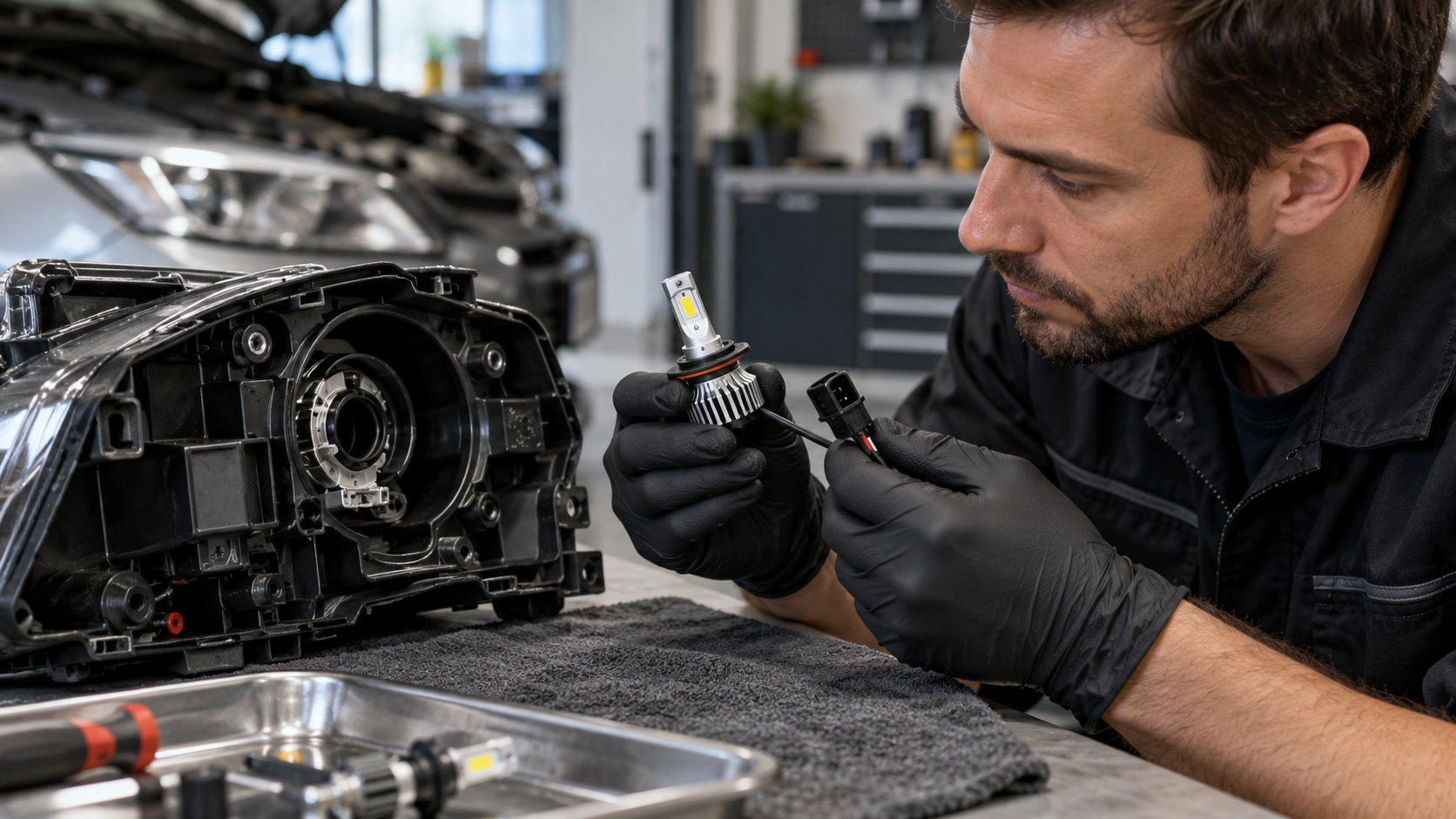

A new LED headlight that stays dark does not automatically mean you need a decoder, resistor, or another bulb. First separate a bulb-side problem from a vehicle-side problem without probing live wiring. If a required headlamp is out, avoid driving at night or in poor visibility until it is repaired.
This is a cautious troubleshooting guide, not a vehicle-specific repair procedure. Your owner’s manual and the exact bulb instructions control. For related bulb and lighting guides, visit our Car Lighting hub.
Important U.S. road-use note
In a February 13, 2024 interpretation, NHTSA said that, under FMVSS No. 108 as it described the standard at that time, no LED replaceable light source was permitted in a replaceable-bulb headlamp. NHTSA also said it generally does not regulate modifications owners make to their own vehicles and that states address installation. On October 6, 2026, NHTSA announced a negotiated rulemaking to review vehicle-lighting standards; that announcement is a review process, not a final rule changing the standard. Before buying or using an LED conversion on public roads in the United States, check current federal and state requirements. This article is not legal advice.
Start with these four checks
- Confirm the bulb and position. Read the vehicle manual or original bulb marking for the exact lamp position. Low beam, high beam, and fog positions may use different parts. A matching-looking socket or a listing for the same bulb family does not prove the replacement is approved or compatible with your exact lamp.
- Switch off and let the lamp cool. Follow the vehicle manual before opening an access cover. If the manual treats the lamp as a service item or access requires removing parts you are not comfortable handling, stop and use a qualified shop.
- Look only at accessible, unpowered connections. With the lighting off, check whether an external connector is visibly loose or whether pins, insulation, or the housing look damaged. Do not probe a live connector, force a keyed plug, cut wiring, or bridge contacts. If anything is melted, wet, corroded, or unclear, stop.
- Use the original bulb as a comparison only if the manual allows a user replacement. If the original bulb works in the same position but the new LED does not, record the exact bulb, vehicle, lamp position, and product model and contact the seller. If neither works, the cause may be in the vehicle circuit; a shop can diagnose it without guessing at add-on parts.
Read the symptom before buying anything
- One new LED is dark: check the exact part and the accessible connector, then use the seller’s return/support path if the original works and the new unit does not.
- Both new LEDs are dark: verify the replacement type and instructions before suspecting two failed units. If the original bulbs also fail, seek vehicle-side diagnosis.
- It flickers, shuts off, or triggers a warning: note when it happens—startup, daytime-running-light mode, or after warming—and share that detail with the vehicle maker, installer, or product support. Do not treat a warning as proof that a decoder is needed.
- There is heat damage, smoke, a burning smell, or a repeatedly blown fuse: switch the lighting off if safe and stop testing. Do not install a larger fuse or keep cycling the circuit.
If the replacement lights but its cutoff or height looks wrong, do not use this checklist to adjust aim. See our headlight-aiming guide for what a visual check can and cannot tell you, and when to use a qualified shop.
When to pause and get help
Pause DIY troubleshooting if you find connector damage, moisture inside the lamp, repeated fuse failures, multiple warnings, or a need for live electrical testing. A qualified technician can determine whether the fault is with the replacement or the vehicle.Before considering another bulb, confirm the exact vehicle year, make, model, trim, lamp position, original bulb marking, and the product’s documented application. AUXITO’s catalog is a starting point for comparing listed options, not proof of fitment for an individual vehicle.
If you have confirmed that your intended use is permitted where you live and verified the exact vehicle application, compare current AUXITO headlight bulb options. If the vehicle-side fault or legal status is unresolved, pause the purchase instead.
Affiliate disclosure: We may earn a commission if you buy through this link, at no additional cost to you.
Sources and limitations
- NHTSA, February 13, 2024 interpretation on LED headlamps and FMVSS No. 108 — addresses replaceable-bulb headlamps and owner modifications; it is not vehicle-specific legal advice.
- NHTSA, October 6, 2026 announcement on reviewing vehicle-lighting standards — announces a negotiated rulemaking process, not a final rule.
- AUXITO headlight bulb collection — shows listed bulb options; the collection is not exact-vehicle fitment or legal-use confirmation.
- Your vehicle owner’s manual and the exact replacement-bulb instructions — required for serviceability, access, fit, and any vehicle-specific procedure.
We did not test these bulbs or diagnose a vehicle. Confirm product details, fitment, and current local requirements before purchase or use.