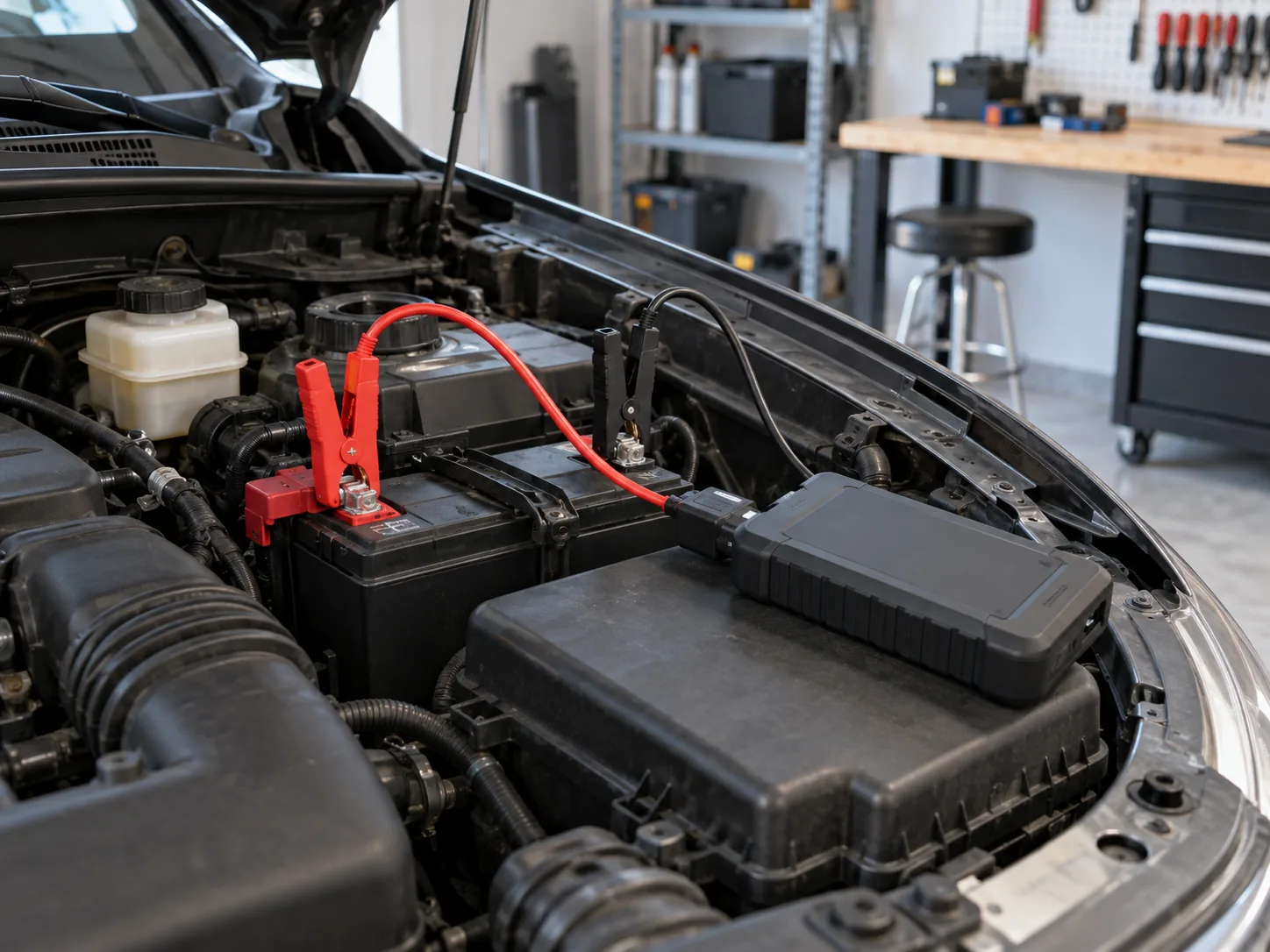

Before You Start (Conditions + Tools)
Move the vehicle to a safe location away from traffic if possible, secure it as directed by its manual, and switch off loads the manual says to turn off. Do not work beside moving traffic, in standing water, or where you cannot keep the clamps and leads controlled. The vehicle manual and jump-starter manual determine whether the particular battery and vehicle may be jump-started and where the leads must connect.
What you need:
- Portable jump starter charged to the level required by its manufacturer
- Clean jumper clamps, no cracked insulation or loose jaws
- Owner manuals for both the car and the jump starter
- Protective equipment specified by the vehicle and jump-starter manuals
Do not proceed if the battery is damaged, frozen, leaking, unusually hot, or has another warning described in either manual. Stop if the vehicle has a high-voltage system warning, the correct 12-volt jump points are unclear, or the manuals do not authorize this method. A jump starter for a 12-volt system must never be connected to a high-voltage traction battery.
Safety Warnings (Read Before Touching Clamps)
Lead-acid batteries produce hydrogen gas and contain sulfuric acid. Sparks near the vent caps, smoking while working, or bridging the clamps together can cause burns, fire, or battery rupture. Electrical safety rules:
- Never touch red and black clamps together while the pack is on. Keep them separated in your hands.
- Follow the exact terminal labels and connection points in both manuals. Never infer a ground point or assume the pack has reverse-polarity protection. If the pack gives a warning or the polarity is uncertain, stop and re-check the manuals.
- Eyes and skin. Wear glasses. Do not lean directly over the battery. If acid contacts skin or eyes, flush with water and seek medical help.
- Use only the starting attempt and rest limits in both manuals. Do not keep cranking when the engine does not start; stop at the limit or warning given by either manufacturer.
- Do not jump a frozen, cracked, or leaking battery. Jump-starting a physically damaged battery risks rupture. Replace or call a pro.
- Ventilation. Work outdoors or in a ventilated garage with the door open. No open flames, cigarettes, or grinding sparks nearby.
If you see smoke, melting insulation, a rapidly swelling pack, or smell burning plastic, disconnect in safe order if you can do so without touching hot metal, move away, and call roadside assistance. If a pack smokes, swells, or catches fire, move away and contact emergency services. Follow the manufacturer's emergency guidance; do not handle a damaged or hot pack.
Step 0: Charge and Readiness Check
A jump starter's storage charge and maintenance interval vary by model. Use its display and follow its manual for charging, storage temperature, inspection, and periodic top-ups; do not rely on a universal percentage or interval.
| Check | What good looks like | Action if not |
|---|---|---|
| Charge indicator | Meets the manufacturer's stated readiness level | Charge with an approved input as specified in the product manual |
| Cables and clamps | Insulation intact, springs strong, teeth clean | Replace cable set or pack; never tape over exposed copper and use it |
| Mode/boost button | Understand normal vs override/boost mode | Read manual now — boost/override bypasses safety checks and must only be used on a confirmed-dead but healthy battery |
| Storage conditions | Within the product's stated temperature and storage limits | Move or replace the pack if it has been stored outside its limits or is damaged |
| Test light | Press test — pack powers its own flashlight/USB | If pack shuts off immediately, recharge fully before trusting it |
Charge and store the pack exactly as its manufacturer instructs. Do not assume a charging duration, input type, temperature range, or unattended-charging rule applies to every model.
What Size Do You Need? Engine, Battery, and Peak Amps Before You Buy or Borrow
Do not skip this before any purchase CTA. A pack that starts a 4-cylinder sedan may not start a cold V8 diesel truck.
| Vehicle type | What to establish | Action before using a pack |
|---|---|---|
| Passenger car or light truck | Exact engine/fuel type, battery system, and manufacturer-designated jump points | Use a pack whose manufacturer explicitly lists the vehicle/application; do not infer capability from peak amps alone |
| Diesel, dual-battery, or commercial vehicle | Whether the pack supports that exact engine/battery setup | If the rating is unclear, use roadside assistance or a qualified service provider |
| Hybrid or electric vehicle | Whether the owner's manual permits external power for the low-voltage system, and the specified connection points | Never attempt to jump the high-voltage traction battery; NHTSA directs owners to the vehicle manual for 12-volt procedures |
Peak-amp figures alone do not establish that a pack will start a particular vehicle. Compare the manufacturer's supported engine/battery applications and operating limits. Do not warm, clean, or otherwise modify a battery or pack unless its manuals give that procedure.
Battery-type note: standard flooded, AGM, and EFB 12V car batteries are the normal jump-box use case. If your vehicle uses a lithium 12V starter battery with a BMS disconnect, follow that battery maker's reset procedure — a standard boost may not wake it.
Steps: How to Connect, Start, and Disconnect (In Order)
There is no safe universal connection order for every vehicle and pack. Use the exact steps and connection points shown in both manuals. If either manual conflicts with this generic overview, stop and follow the manufacturer's instructions or contact qualified support.
Generic checks only; do not use these as a substitute for the model-specific procedure:
- Identify the exact 12-volt battery or remote jump points named by the vehicle manual. Do not choose a ground point by guesswork.
- Inspect the pack, clamps, and leads. Do not use damaged or exposed wiring.
- Connect clamps only in the order and locations specified by the vehicle and pack manuals. Keep clamps separated and clear of moving parts.
- Stop if the pack signals reverse polarity, the connection points are uncertain, or anything heats, smokes, sparks abnormally, or smells burnt.
Start:
- Operate the pack and attempt to start the vehicle only as directed by the manuals. Obey their crank-time and rest limits.
- If it does not start within the stated limit, stop. Do not repeatedly retry or use a boost/override mode unless the exact manuals explicitly permit it under the present conditions.
Disconnect (reverse order, engine running):
- Switch off/disconnect the pack and remove clamps only in the order specified by both manuals. Keep them apart during removal and storage.
- A jump-start does not diagnose or repair the cause of battery discharge. Follow the vehicle manual for what to do after starting, and arrange a battery/charging-system test if the battery repeatedly goes flat.
- Stow cables so clamps cannot short in the storage bag.
Do not use override/boost mode unless the manual's exact conditions are met (healthy but deeply discharged battery, correct polarity triple-checked, you accept the risk). Override disables protections — wrong use can damage electronics.
Post-Start Check (5 Minutes That Prevent a Repeat Tow)
- Dashboard: if a battery or charging warning remains on, do not guess which component failed. Follow the vehicle manual and arrange a battery and charging-system diagnosis before relying on the car.
- Voltage behavior: headlights steady, blower normal, no burning smell.
- Terminals: tight, no wobble, no fresh white/green crust. Tighten and clean if loose.
- Pack: recharge the jump starter to full the same day. A used pack left half-empty is useless next time.
Test low/high beams, brake lights, and hazards after any electrical event — a voltage dip sometimes exposes a weak bulb or blows an already-tired fuse.
Common Mistakes
| Mistake | Why it hurts | Do instead |
|---|---|---|
| Clamps on painted or greasy metal | High resistance, clicks but no crank | Bare unpainted bolt or post; wire-brush first |
| Reversed red/black | Blown main fuse, ECU damage | Stop at any alarm; verify +/− caps and cable colors twice |
| Repeated or prolonged cranking | Can exceed limits for the starter or pack | Follow the crank/rest limits in both manuals; stop when either says to stop |
| Using boost/override as default | Bypasses reverse/short protection | Normal mode first; override only per manual on healthy battery |
| Storing pack discharged or outside its stated temperature range | It may not be ready when needed | Store and recharge at the intervals and temperatures specified in that model's manual |
| Jumping a cracked/leaking battery | Acid spray, rupture risk | Stop — replace or tow |
| Connecting directly to trunk battery when manual says use under-hood posts | Bypass sensor, fault codes | Follow car manual jump points |
When to Stop and Ask a Pro
Stop jump attempts and call roadside assistance or a shop if: battery case is cracked, swollen, leaking, or hot; strong sulfur smell persists; cables or clamps get hot/smoke; main fuses blow repeatedly; the car starts then dies immediately (likely alternator/charging fault); the vehicle is a hybrid/EV with high-voltage warnings; or the vehicle repeatedly will not start within the attempt limits in its manual. Those are system faults, not low-charge events. A pro load-tests the battery, checks parasitic drain, and inspects the alternator — a fourth or fifth jump just masks it.
AUXITO Options: How to Use the Collection Without Hype
Start from the regular category page (not an affiliate link here): https://auxito.com/collections/jump-starters-battery-tools — plus the site support/manual pages.
Verify on the live page, dated: which engine displacements (gas/diesel liters) each model is rated for, peak amps and battery capacity (mAh/Wh), clamp/cable design, safety protections listed (reverse-polarity, short-circuit, over-current, over-temperature), and warranty/return terms. Do not copy peak-amp or "starts any truck" claims unless the live page states them for your engine size on that date.
- Consider a pack only if its current manufacturer documentation explicitly lists your exact engine/battery application and operating conditions.
- Do not select by peak-amp number or engine-cylinder count alone; compare the exact use-case rating and the vehicle/pack manuals.
- Avoid / delay if: dual-battery diesel, cracked/leaking battery, or repeated no-start after 3 attempts — fix the battery/charging system first.
Best Next Step + CTA
If you have confirmed a healthy but discharged standard 12V battery (no cracks, leaks, or swelling), know your engine size and battery type, and the pack is rated for your displacement:
After confirming your engine size, 12V battery type, and required peak current from your owner manual, compare current AUXITO jump starter options here: Compare AUXITO jump starters
Disclosure: As an AUXITO affiliate, I may earn a commission if you buy through this link, at no extra cost to you.
Need the manual path first? Check jump starter manuals and support
Related buying guides
Before choosing a pack, compare the trade-offs in our jump starter vs. jumper cables guide. Then verify vehicle and model compatibility with the jump-starter sizing guide. These are buying checks, not a substitute for following your vehicle and device manuals.
Sources and verification
Jump-starting steps vary by vehicle and pack, so this guide defers to both manuals. NHTSA directs hybrid and electric vehicle owners to consult the owner's manual for 12-volt jump-starting procedures. AUXITO listings and supported applications can change; confirm the exact model instructions and application on the live page before buying. These references are not independent product tests.
- NHTSA: Electric and Hybrid Vehicles (accessed October 18, 2026)
- AUXITO: Jump Starters & Battery Tools collection (listings checked October 18, 2026)
FAQ
How long do I charge a new jump starter? Charge it until its manual's stated ready indication is reached. Required time, input, storage level, and maintenance interval vary by model.
What order should I connect the clamps? There is no universal clamp sequence for every vehicle and portable pack. Follow the exact connection and removal procedure in both manuals, including any remote jump posts.
How many start attempts are safe? There is no universal number. Follow both manuals' crank and rest limits. If the vehicle does not start within those limits, stop and seek diagnosis or roadside assistance.
Can I jump-start in the rain? Do not use a pack or handle connections in wet conditions unless both manuals permit it and the work area is safe. Keep the pack and connectors within the manufacturer's stated conditions; if water, damage, or uncertainty is present, stop and call for assistance.
Do I need to idle after a jump? Follow the vehicle manual. A jump-start does not confirm that the battery has recovered; have the battery and charging system checked if the fault returns.
Why did my car die again the next morning? Aging battery, parasitic drain (trunk light, dashcam), or failing alternator. Get a load test — repeated jumping is not a fix.