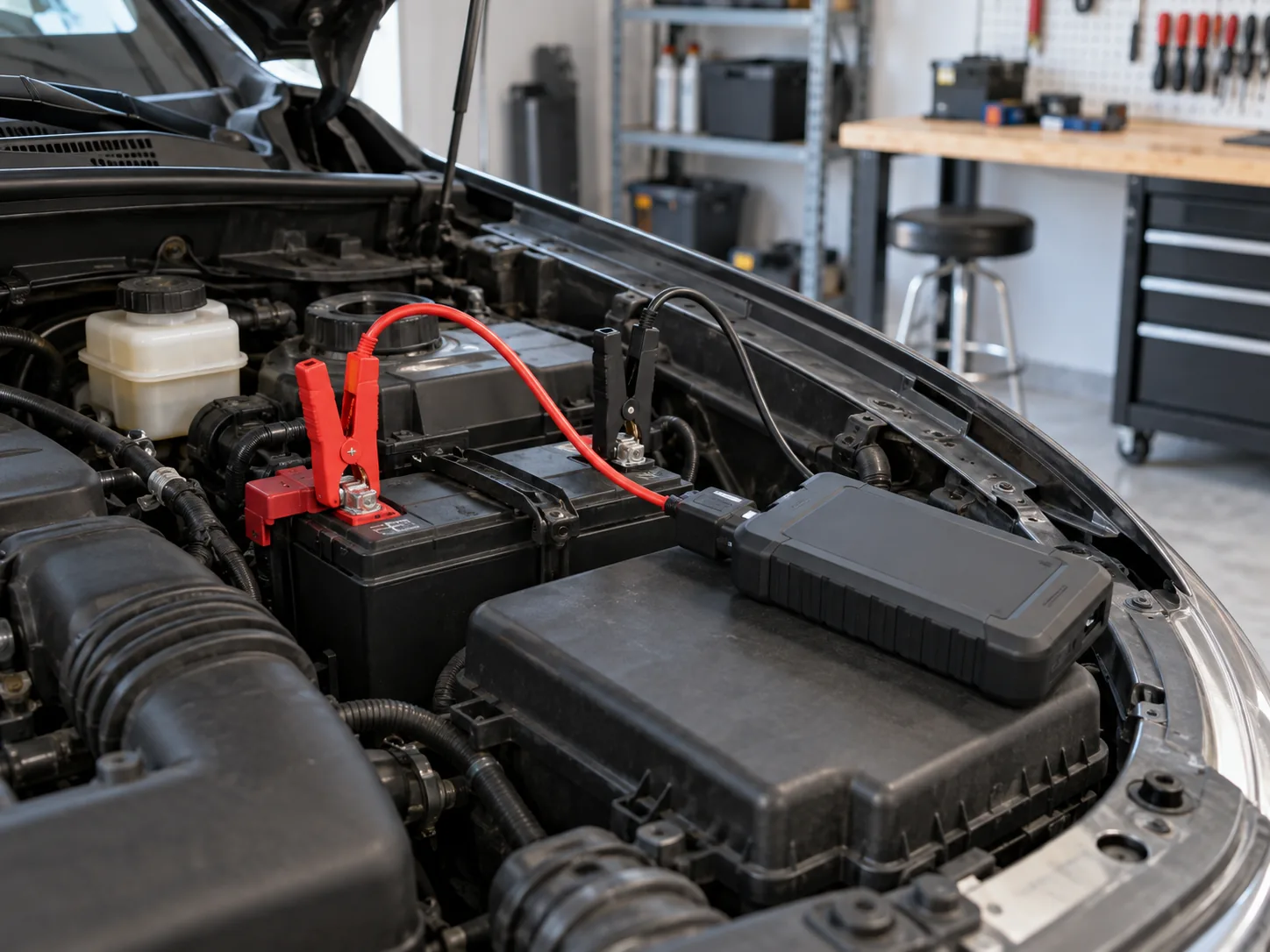

Portable Jump Starter Buying Guide: Match It to Your Vehicle
A portable jump starter is useful only if it matches the vehicle and is ready when the battery will not crank. The number printed largest on the box is not enough to choose one. Start with the vehicle's voltage, engine type, and the jump-start directions in its owner's manual; then compare the exact starter's supported limits and safety instructions.
Start with your vehicle and its owner's manual
Write down the vehicle year, make, model, engine, and whether it is gasoline or diesel. Then consult the owner's manual for the battery voltage and designated jump-start terminals. Do not assume the battery is easy to reach or that the negative terminal is the correct connection point. Some vehicles specify remote posts or a particular grounding point.
This is especially important for hybrids and electric vehicles. A portable 12-volt booster is not a tool for charging or jump-starting a high-voltage traction battery. Some vehicles permit a 12-volt boost for accessories or to enable a start sequence, while others specify different steps. Follow the exact vehicle manual; if it does not clearly allow the procedure, call roadside assistance or a qualified technician.
If the manual identifies a nonstandard voltage or a special procedure, stop shopping by generic “car” or “truck” labels. Only consider a device whose manufacturer explicitly supports that vehicle's system and use case.
Read the rating as a model-specific limit
Jump-starter listings often emphasize peak amps. Treat that number as one comparison point, not a promise that the pack will start every engine of a stated size. Peak-current figures are not necessarily measured or presented identically across brands. Product support wording, battery condition, temperature, connection quality, and the exact procedure all affect whether a start is possible.
Check the exact model page and manual for:
- Supported vehicle voltage.
- Supported gasoline and diesel engine size, stated separately when applicable.
- Any limitations for repeated starts or cold conditions.
- Whether a low-voltage or manual-override mode exists and the conditions for using it.
- Minimum or maximum battery conditions, if the manufacturer specifies them.
- The required cable/clamp assembly and connection sequence.
Do not choose a model because an adjacent variant has a higher rating. Model names can cover different capacities, and a collection page can change. Match the exact SKU or configuration shown on the box and product page to the manual before purchasing.
Choose by the situation you actually face
| Your situation | What to prioritize | What could make the choice wrong |
|---|---|---|
| Small gasoline car, mild climate, occasional emergency kit | A compact model whose manual explicitly covers the engine and vehicle voltage | Buying by “peak amps” without checking the supported engine range |
| Pickup, SUV, or diesel vehicle | A model with a manufacturer-published rating for that exact engine type and size; sturdy clamps and adequate cable reach | Assuming a rating for gasoline engines also applies to diesel |
| Regular sub-freezing weather | Documented operating/storage temperature limits and a plan to keep the unit within those limits | Leaving a lithium pack in a location outside its permitted temperature range |
| Several vehicles in the household | Verify every vehicle separately; choose only if the same unit's documentation covers them all | Treating “fits cars and trucks” as confirmation for every engine |
| You want a light, small emergency kit | Size and weight after the core compatibility checks pass | Giving up required starting capability for a smaller case |
If your vehicle is near the top of a published engine-size range, do not treat that as generous headroom. Compare the exact manufacturer's wording and consider asking the manufacturer or a reputable installer before buying. A larger advertised number is not a substitute for a supported-vehicle statement.
Put safety before convenience features
Read both manuals before an emergency: the vehicle manual and the jump starter's manual. Their directions take precedence over generic diagrams online. Do not use a booster on a battery that is visibly damaged, leaking, swollen, or frozen. Stop if the clamps, cables, or case are damaged, if the unit reports a connection or temperature error, or if you are unsure which terminal or approved ground point to use.
Work in a ventilated area and keep sparks, flames, and smoking materials away from the battery. Wear eye protection. Do not improvise a connection sequence or enable an override simply because a normal connection does not work. For a specific example, NOCO's GBX45 instructions warn against jump-starting a damaged or frozen battery and limit use to batteries of the recommended voltage. That is guidance for that named model, not a universal procedure for other boosters.
The 2008 AAA battery-care brochure likewise tells readers to check the vehicle owner's manual because its own jump-start procedure is generic. Its age is a reason to use it only for that general caution, not as current instructions for a modern vehicle. If the vehicle manual is unavailable or the battery appears unsafe, do not guess; use professional roadside help.
Check clamps, charging, and storage
Clamp quality and cable reach matter in the real vehicle. Compare the lead length and clamp shape with the location of the vehicle's approved jump posts. A short lead may not reach safely; a clamp that cannot grip the specified post is not made workable by a high power rating.
Then check how the pack is recharged and how it signals a low charge. Choose a recharge method you will actually use, and follow the model's stated storage and recharge interval. A unit left empty in the trunk is not emergency-ready. Do not infer a universal maintenance interval: use the exact manual, and check the charge indicator on the schedule it gives.
USB outputs, a flashlight, a display, an air compressor, or a carrying case can be useful. They are secondary. First confirm voltage, engine support, the approved procedure, clamp reach, and storage limits. An air-compressor combo is larger and adds a different tool; buy that extra function only if you have a separate use for it.
Before-you-buy checklist
Use this short list when comparing product pages:
- Vehicle year, make, model, engine, and gasoline/diesel type are recorded.
- The owner's manual confirms the voltage and approved jump points or procedure.
- The exact starter manual names a supported voltage and engine range that covers this vehicle.
- Any cold-weather and storage limits fit where the unit will be kept.
- Clamps and cable can reach the approved connection points without stretching or unsafe routing.
- Safety indicators, recharge instructions, and any override procedure are understandable before an emergency.
- Required cables, case, charger, or other accessories are included or budgeted separately.
If any of the first four checks is unresolved, do not buy on the basis of a broad “universal” label. Send the vehicle and exact model details to the manufacturer's support team or choose roadside assistance instead.
Frequently asked questions
How many amps does my jump starter need?
There is no single amp number that guarantees a start. Use the exact model's supported engine and vehicle-voltage information, and do not compare peak-amp claims as though every manufacturer measures them the same way.
Can I use a portable jump starter on a hybrid or EV?
Only if the vehicle manual permits that specific 12-volt procedure and connection point. A portable booster does not jump-start the high-voltage traction battery. When the manual is unclear, call the automaker or roadside assistance.
Will a jump starter work on a completely dead battery?
Not necessarily. Some devices require a minimum battery voltage or have a model-specific override; a battery can also be damaged rather than merely discharged. Follow the exact instructions and do not use an override to bypass a warning or unsafe battery condition.
Should I buy a jump starter with an air compressor?
Only if you also want and will maintain the compressor. It adds bulk and another function to check. Do not let it outweigh the vehicle-compatibility and safety checks for the jump-start function.
Next step
Before comparing models, find your vehicle's jump-start section and note its designated posts and voltage. Then compare those details with the exact starter manual. If you are ready to browse options, the AUXITO jump starter collection is one collection to compare; check each current model's own limits and instructions before choosing. This is a collection link, not a recommendation that any listed model fits your vehicle.
Affiliate disclosure: ModernCarGear may earn a commission if you buy through this link, at no additional cost to you. The link does not change the compatibility checks above.
Sources and claim scope
| Source | Fact used | Scope and limitation | Checked |
|---|---|---|---|
| NOCO GBX45 data sheet and user-guide safety information | The named model specifies voltage and temperature limits and warns against using it with a damaged or frozen battery | Example of model-specific limits and warnings only; not instructions for other brands | 2026-10-09 |
| AAA, Make Sense of Car Care: Batteries | The brochure labels its jump-start steps generic and directs readers to the vehicle owner's manual; it warns against jump-starting a frozen battery | Published 2008; cited only for the general need to prioritize the vehicle manual and stop for a frozen battery, not as current procedure | 2026-10-09 |
| AUXITO Jump Starters & Battery Tools collection | The retailer currently lists multiple jump-starter models and variants | Collection listing only; no claim here that a specific model fits a specific vehicle; listings and specifications can change | 2026-10-09 |