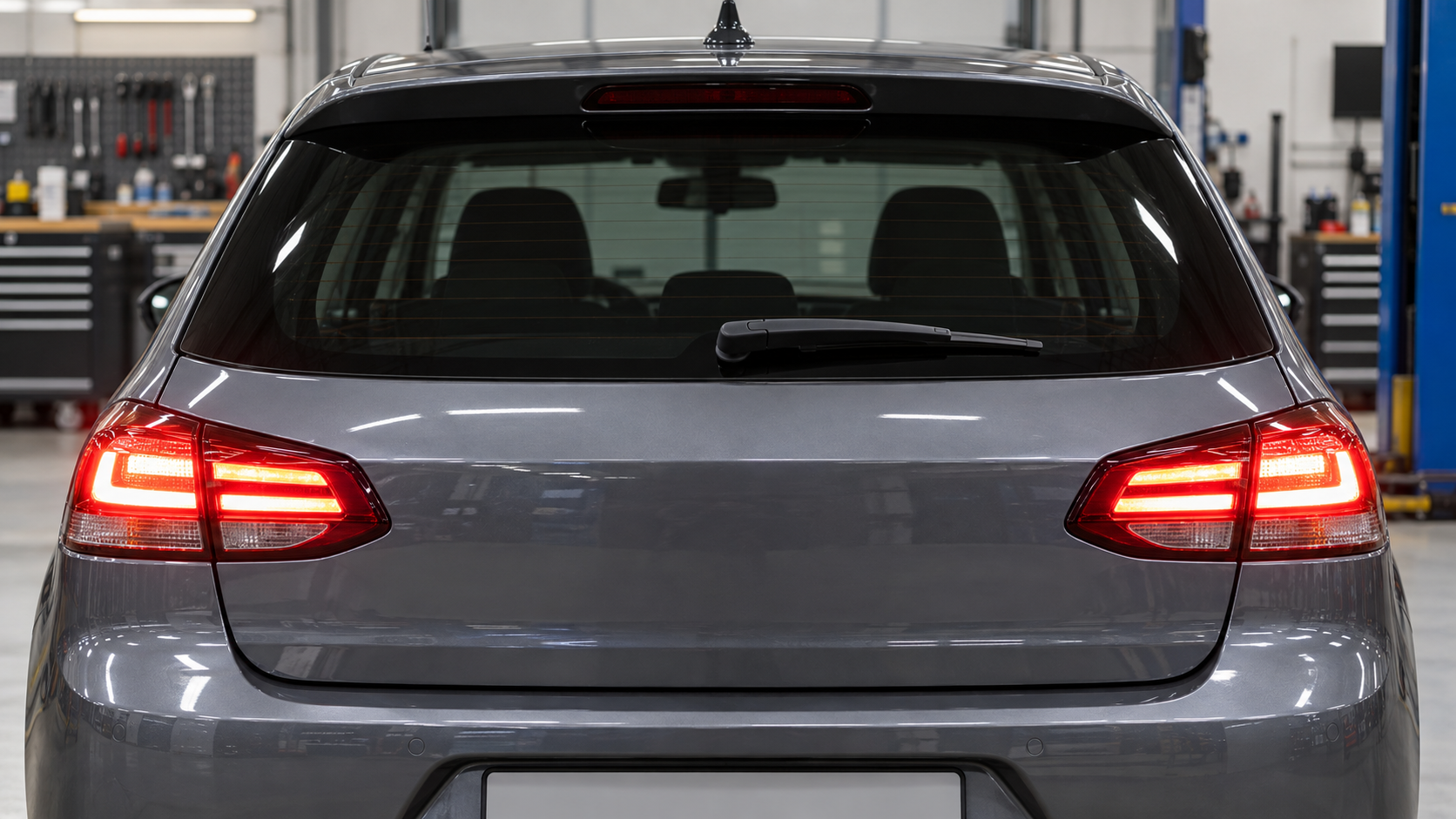

When your third brake light is out but the two side brake lamps still work, do not buy a bulb yet. The center lamp may be serviced differently from the outer lamps. First confirm which light has failed, then identify the exact service part for your vehicle.
Check the symptom safely
Park on level ground, set the parking brake, and keep the vehicle in Park or in gear as appropriate. Ask another person to watch the rear lamps while you press the brake pedal. If you are alone, use a safe reflection or a phone recording from a position that does not put you in traffic. Do not stand behind a vehicle that could roll.
Record whether the left, right, and center lamps illuminate. If all brake lamps are out, do not drive in traffic until they work again. Arrange qualified diagnosis rather than treating it as a simple bulb replacement.
Only the center lamp is out: identify the service part
Working outer brake lamps do not tell you what failed in the center lamp. Find the center high-mounted stop lamp section in the owner's manual and check whether it describes a user-replaceable bulb. If it does not, use a VIN-specific parts catalog or ask a parts professional to identify the assembly by VIN and body style. Do not infer the part from another trim or model year.
Open an access panel only if the manual or service instructions explain how. If a bulb replacement is specified, use the exact type listed for that lamp and follow the vehicle procedure. If the manual identifies an assembly, do not try to fit a generic bulb into it.
If the lamp is intermittent or visibly damaged
Note when the center light cuts out: every time, only after rain, or when the trunk or hatch moves. That history can help a technician, but it does not prove whether the bulb, connection, wiring, or lamp assembly is responsible. If you see damaged insulation, corrosion, moisture inside the housing, or heat damage, stop before probing the circuit.
Do not bridge terminals, scrape sealed connectors, or install a higher-wattage bulb to compensate for a dim lamp. Electrical testing requires the correct vehicle wiring information and tools. If those are not available, have a qualified technician diagnose it.
What the regulation does and does not tell you
U.S. Federal Motor Vehicle Safety Standard No. 108 covers vehicle lighting equipment. The current eCFR text for 49 CFR 571.108 defines a high-mounted stop lamp as intended to give a steady stop warning and sets equipment requirements. It is not a model-specific repair manual or a complete guide to state inspection rules. Do not remove, cover, or modify required lighting; check the requirements that apply to your vehicle and location.
Verify the repair
After the repair, have a helper check the left, right, and center brake lamps while you press and release the pedal. Confirm the center lamp illuminates steadily and turns off when released. If more than one brake lamp remains out, a warning appears, or the brake pedal feels abnormal, stop troubleshooting and arrange service.
Common questions
Can I drive with the third brake light out?
Repair a failed stop lamp promptly and check the local requirements for your vehicle. If the two outer lamps are also out or the brake system behaves abnormally, do not continue driving in traffic; arrange qualified service.
Does every third brake light have a replaceable bulb?
No single answer applies to every vehicle. Check the owner's manual or VIN-specific parts information before ordering a bulb or assembly.
Why do the side brake lights work but the center light does not?
The symptom narrows the issue to the center lamp's path, but it does not identify the failed component. Use the vehicle's service information or a qualified technician for circuit diagnosis.
Next step
Test all three brake lamps, record which ones fail, and look up the center lamp by VIN and body style. Buy a bulb only if the manual confirms it is replaceable; otherwise identify the correct assembly or ask a technician to diagnose the circuit. See the Car Lighting Hub for related lighting guides.
Related Guides
- Brake Light and Tail Light Bulb Guide — Check the exact lamp position and bulb type before choosing a replacement.
- 3157 LED Bulb Guide — Verify socket and dual-intensity fitment before choosing a 3157 replacement.