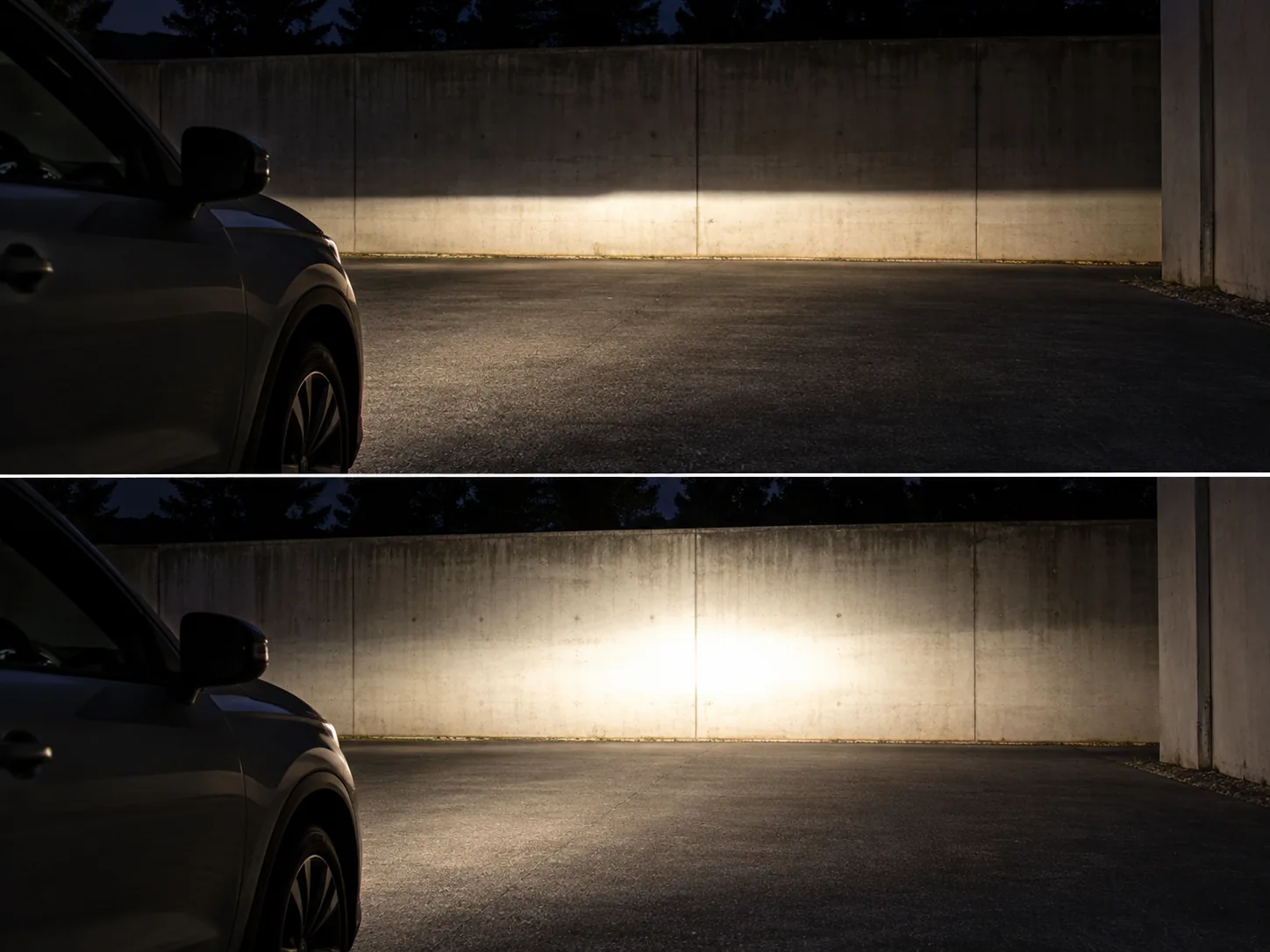

The short answer: use high beams when the road ahead is dark and no nearby driver would be dazzled. Switch to low beams when meeting or following traffic, or when the high-beam pattern would shine into another driver’s eyes.
Choose the beam for the road in front of you
Low and high beams are not simply “dim” and “bright” versions of the same light. Their beam patterns trade forward visibility against glare for other road users. NHTSA describes high beams as providing more light at longer distances, while low beams reduce light in areas that can glare oncoming or preceding drivers. NHTSA explains the visibility and glare roles of upper and lower beams.
Dark, open road with no nearby traffic
High beam may help you see farther ahead. Return to low beam as soon as traffic or conditions call for it; the upper-beam pattern is designed for longer-distance illumination.
Meeting or following another vehicle closely
Use low beam so your lights do not shine into another driver’s view or mirrors. NHTSA describes lower beams as reducing glare toward oncoming and preceding traffic.
Streetlights or changing visibility with automatic switching
Keep watching the road and switch manually when needed. As the 2022 Honda HR-V manual notes for that model, weather, street lighting, curves, and other vehicles can affect auto-high-beam switching.
Automatic high beams still need your attention
Some vehicles switch beams automatically, but the feature is not universal and may not be available on every trim. In the 2022 Honda HR-V manual, the auto-high-beam system is described as an assist: Honda says the driver should keep watching surroundings and switch manually if needed. The manual also lists weather, street lighting, curves, and other vehicles among situations that can affect switching. That is a model-specific example, not a rule for every car. See the 2022 Honda HR-V headlight instructions.
If a beam is out, do not shop by “low” or “high” alone
The beam name describes a lighting function, not a bulb number. A vehicle may use separate light sources, a combined bulb, or a system that the owner’s manual does not list as a user-replaceable bulb. Start with the manual for your exact year, make, model, trim, and market. Find the headlight bulb-replacement section and match the specified lamp position before ordering.
- Park safely and note which side and which function is affected: low beam, high beam, or both.
- Check the vehicle manual to see whether that position has a replaceable bulb or requires service of a larger assembly.
- Confirm the bulb designation for that exact vehicle and position in the manual or a vehicle-specific parts lookup; do not infer it from the beam label.
- If the manual does not describe a user-replaceable bulb, or the issue is not clearly the light source, ask a qualified shop to identify the correct repair before buying parts.
For vehicle-specific bulb guides and fitment checks, start at the Car Lighting Hub. Its first step is matching the vehicle and lamp position, not guessing from a bulb-family name.
Bottom line
Choose high beam for longer-range visibility only when it will not glare nearby road users; choose low beam around traffic and whenever the road situation calls for less glare. If a bulb is out, identify the exact vehicle position and service part from the owner’s manual before ordering. Beam choice and bulb fitment are separate questions.