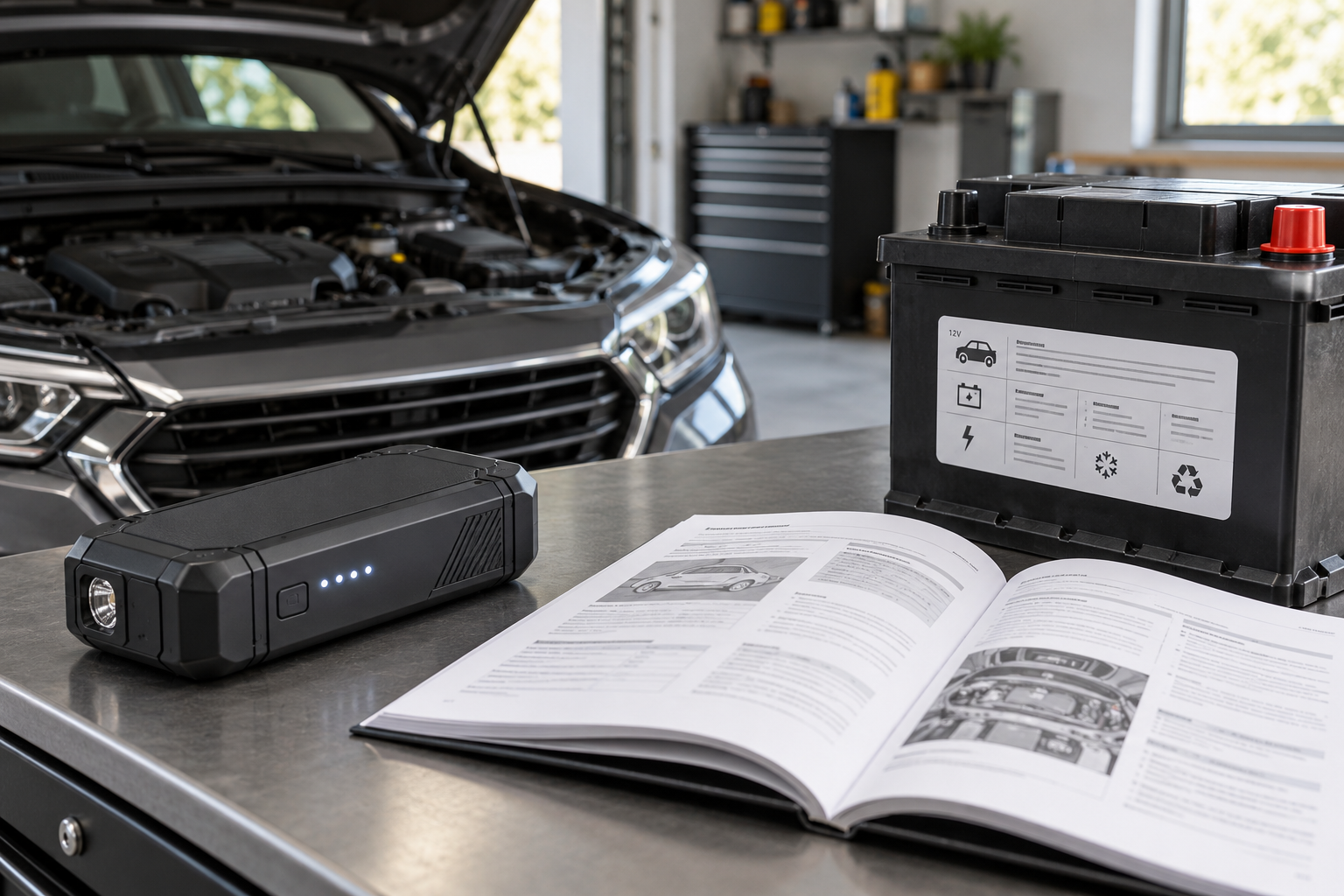

There is no reliable universal chart that turns engine size into one exact peak-amp number. Jump-starter labels use maker-specific ratings, and the correct choice depends on the exact vehicle, its low-voltage system, battery condition and the device’s stated coverage. Start with the vehicle manual and compare its requirements with the exact model—not with a generic “amps by engine” table.
This is a research-based guide, not a hands-on product test. It does not diagnose a battery or authorize work on high-voltage hybrid/EV components. For more equipment decision guides, visit our Car Accessories hub.
Do this lookup before comparing amp numbers
- Open the owner’s manual. Find the battery/jump-start section. Record the system voltage, approved jump points, battery restrictions and any special steps for start-stop, hybrid or auxiliary-battery configurations.
- Record the engine exactly. Note fuel type and displacement from the vehicle documentation. “Truck” or “V8” alone is not enough to match a specific model rating.
- Check the battery setup. Read the battery label or manual for chemistry/type and whether the vehicle has one or more low-voltage batteries. If the arrangement is unclear, ask the vehicle maker or a qualified shop.
- Compare the exact jump-starter listing and manual. Confirm that they explicitly cover your engine/fuel type, voltage and battery setup. If the listing gives only a peak-amp headline and no relevant coverage, treat compatibility as unverified.
AAA advises buyers to consider the vehicle’s engine size and the jump starter’s stated peak or cranking output, alongside safety features. That is a starting point, not a substitute for the exact product manual and vehicle requirements. See AAA’s jump-starting guidance.
What the ratings can—and cannot—tell you
- Peak amps: a manufacturer’s maximum short-duration output claim. It is not a universal cross-brand measurement and does not by itself prove that a pack can start your vehicle.
- Cranking/starting amps: useful only when the maker defines the test and duration. Do not compare two labels as equivalent unless their methods are comparable.
- Engine coverage: the most actionable statement when a manufacturer explicitly names gas or diesel displacement. Check the exact model, not merely the brand or collection.
- Battery capacity (Wh or mAh): describes stored energy under stated conditions; it is not the same thing as starting output or a guaranteed number of starts.
- Temperature and operating limits: use the manual’s stated range and sequence. Do not assume that a larger amp number cancels a cold-weather restriction.
If a product page uses a large headline number but omits the engine coverage or manual, do not “size up” by guessing. Choose a model with clear documentation, contact the manufacturer with your vehicle details, or use roadside assistance.
Special cases where a generic size chart is a bad shortcut
Diesel, large-displacement or multiple-battery vehicles
Do not translate a gas-engine rating to a diesel or infer coverage from cylinder count. Look for the exact fuel type and displacement in the device’s current documentation. For dual-battery or commercial systems, require explicit coverage; if it is absent, do not assume one consumer pack is suitable.
Start-stop systems and remotely located batteries
The vehicle may provide designated under-hood jump points or a specific ground point. Follow the vehicle manual rather than connecting wherever the battery is easiest to reach. The jump-starter manual must also permit the setup.
Hybrid and electric vehicles
A portable booster, where permitted, would apply only to the low-voltage auxiliary system and the exact procedure in that vehicle’s manual. It is never a tool for the high-voltage traction battery or orange high-voltage wiring. If the manual does not clearly authorize the action, stop and contact roadside support.
Use this go / pause decision
- Proceed to compare models only when the vehicle manual identifies the approved procedure and a product manual explicitly covers your vehicle’s voltage, fuel/engine class and battery arrangement.
- Pause and ask the manufacturer or a shop when the pack’s listing is incomplete, your vehicle has multiple batteries, or vehicle and product instructions appear to disagree.
- Do not jump the battery if it is cracked, leaking, swollen, frozen, unusually hot or otherwise damaged. A bigger pack is not a safe remedy.
- Seek diagnosis if the battery repeatedly needs a boost, the vehicle starts and then stalls, or there are electrical warnings. The underlying issue may be the battery, charging system or a drain.
What else to check after compatibility
Once the model is explicitly rated for your vehicle, compare its clamp reach, connection indicators, protective features, charging method, storage/temperature limits and warranty/support. These details affect whether you can use and maintain it; they do not expand its stated engine coverage.
Keep the pack charged and stored exactly as its own manual says. There is no safe universal recharge interval for every model. Check the indicator before a trip and after use, and do not leave a lithium pack exposed to temperatures outside the maker’s limits.
Where AUXITO models fit
AUXITO’s current jump-starter collection lists several models. That collection page does not establish which model fits your vehicle, and a brand’s peak-amp figure should not be treated as an independent test. Open the exact model page and manual, then compare the listed engine/fuel coverage and limits with the vehicle manual. We have not independently tested these products.
Affiliate disclosure: We may earn a commission if you buy through this link, at no additional cost to you.
After recording your engine, fuel type, voltage and battery setup, compare current AUXITO jump-starter options and verify the exact model’s documentation. For the separate choice between a pack and cables, read our jump starter vs. jumper cables comparison. For use precautions, see the portable jump-starter safety guide.
Frequently asked questions
What size jump starter do I need for a V8?
There is no dependable answer from “V8” alone. Record the exact gas/diesel displacement and battery setup, then select only a model whose current documentation explicitly covers them.
Is a higher peak-amp number always better?
No. A peak figure without a clear test definition and engine-coverage statement is not enough to establish suitability. Match the documented use first; compare features second.
Can one jump starter work for both gas and diesel?
Only if that exact model’s current documentation explicitly lists both and includes the relevant engine sizes. Do not infer diesel capability from its gas rating.
What if the vehicle manual and jump-starter instructions differ?
Do not improvise or combine steps. Contact the vehicle or device manufacturer for clarification; use roadside assistance if a safe, approved procedure cannot be confirmed.
Sources and limitations
- AAA Club Alliance, How to Use Jumper Cables — general jump-start safety and buyer considerations; it does not certify any AUXITO model for a particular vehicle.
- AUXITO jump-starter collection — confirms the category currently lists products; exact-model claims must be checked on the live model page/manual.
- Vehicle owner’s manual — required source for the exact vehicle’s voltage, approved jump points, battery configuration and procedure. Consult the manual for the vehicle being serviced.