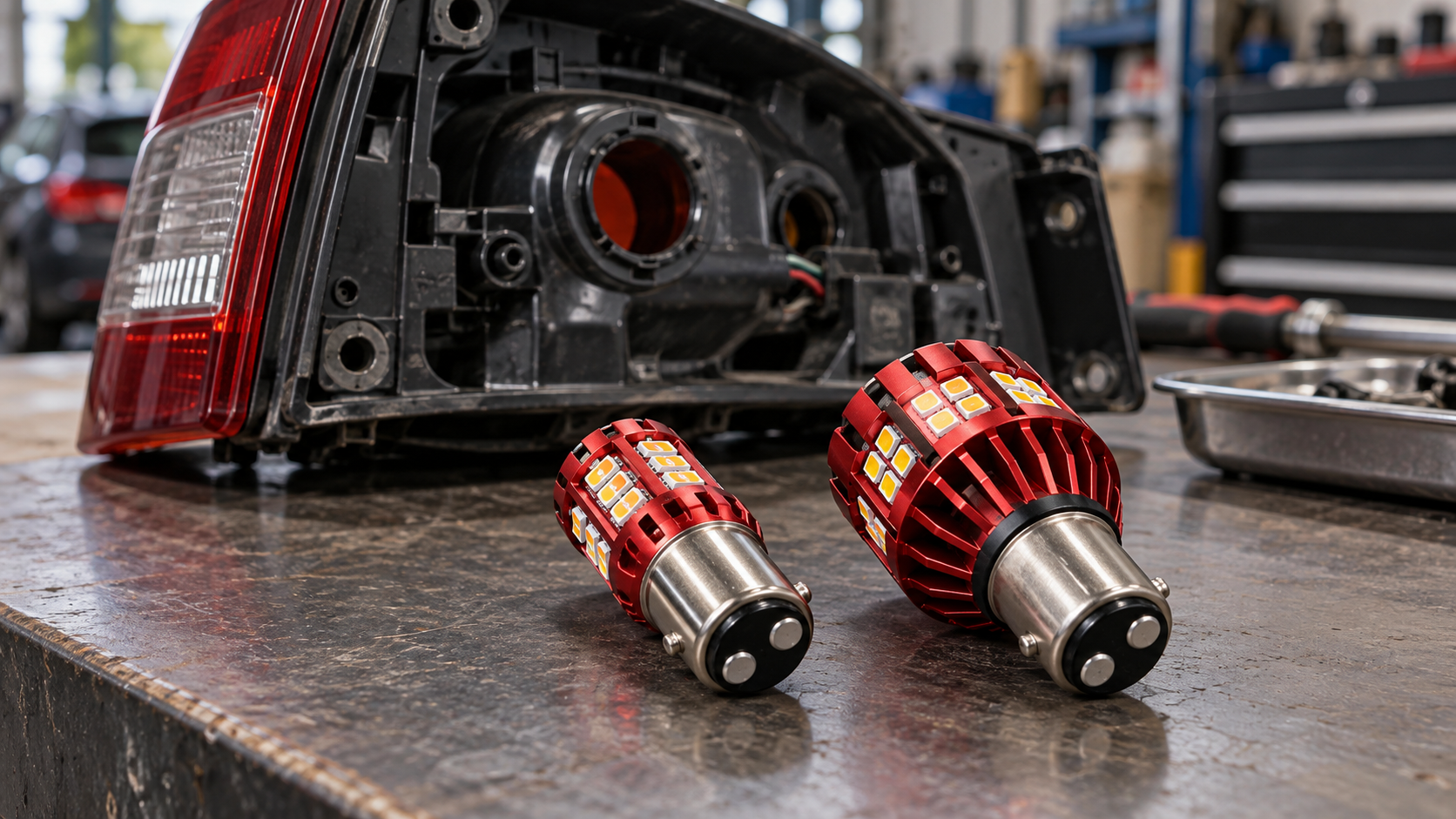

An 1157 brake/tail LED must preserve two distinct outputs: a lower tail-light level and a brighter brake-light level. If you have not confirmed that the exact rear position uses a red 1157/BAY15D bulb, stop before comparing models. This is a comparison of AUXITO’s current product listings, not independent brake-lamp photometry or vehicle testing.
Confirm the bulb and function first
- Check the owner’s manual or a vehicle-maker parts source for the exact year, trim, market, rear position, and bulb code.
- If the bulb is safely accessible, confirm the marking and compare the base/contact arrangement. Do not substitute a single-function bulb based on appearance alone.
- Confirm the lens and vehicle require a red bulb at this position. A bulb code does not settle the correct color or legal use.
- Before ordering, note whether this socket also serves a turn signal and whether the car monitors bulb load.
Two AUXITO red 1157 options, without a lab-test winner
| Listing | What AUXITO states | Who may want to inspect it | Limit to keep in mind |
|---|---|---|---|
| Standard red 1157/BAY15D | The page explicitly describes dim tail and bright brake modes, 7 W per bulb, 1,200 lm per bulb, and 9–18 V DC. | A buyer who wants the product page to clearly state the two brightness functions. | These are manufacturer-listed values, not a measured brightness or visibility comparison. AUXITO notes that some sensitive vehicles may need a load resistor or flash relay. |
| 4KP8 red 1157 with built-in resistor design | The page describes a red 1157-family bulb with a built-in driver/resistor design and lists 4,000 lm per pair. | A buyer whose manual confirms 1157 and who wants to compare an integrated electronics design, not a way to cure an existing warning. | The listing still says some vehicles may have CANbus or installation issues. “Built-in” does not guarantee warning-free operation in every vehicle. |
The listings do not provide a controlled, same-lamp test that would justify a universal “best overall” or a claim that one is safer or brighter in your vehicle. Treat the specifications as AUXITO’s claims and compare the exact selected variant, package, dimensions, and electrical notes.
Choose a next step by your situation
- You mainly need the two rear-light functions: Start with the standard listing because it explicitly identifies the dim-tail/bright-brake behavior. Confirm the bulb code and test both functions after installation.
- Your car already has a bulb-out warning or other LED load issue: Do not treat the 4KP8 or its built-in electronics as a fix. Diagnose the vehicle-side cause first; ask AUXITO about the exact vehicle only after confirming the specified bulb and position. Do not add a resistor or change wiring by guesswork.
- The socket also signals: Confirm the product is intended for that combined application and separately test tail, brake, turn, and hazard functions. A brake/tail product page alone does not establish signal compatibility.
- The housing is cramped or the socket is heat-damaged: Measure clearance and repair a damaged socket before choosing a larger LED body. Do not force the lens or leave its seal compromised.
Check both brightness levels after installation
Follow the vehicle and product instructions. With the vehicle secured, switch on the tail lamps and confirm the lower-intensity mode. Have a helper press the brake pedal and verify a clear increase on both sides. If the same position also signals, check turn and hazard operation. Stop if either level is absent, a warning or abnormal flash appears, the bulb is loose, or the housing will not close. Reinstall the specified bulb or have the socket/circuit checked rather than assuming the LED itself is the fix.
Bottom line
The standard AUXITO 1157 page makes the dual-brightness function explicit; the 4KP8 page offers a built-in electronics design but does not promise universal compatibility. Confirm the 1157/BAY15D position and circuit first, then choose which listing is worth checking. If your vehicle uses 7443 or 3157 instead, this comparison does not apply; use the code specified for that exact position.
Your next step
Once you confirm a red 1157/BAY15D dual-function position, compare the standard AUXITO red 1157 with the AUXITO 4KP8 red 1157 listing. Check the selected package and your vehicle’s electrical notes before ordering.
Affiliate disclosure: ModernCarGear may earn a commission if you purchase through these links, at no additional cost to you. See our affiliate disclosure.
Related guides
Sources
- AUXITO standard red 1157 product page — dual brightness, listed wattage/output, voltage, and vehicle-specific caveat; manufacturer claims, checked Oct. 17, 2026.
- AUXITO 4KP8 red 1157 product page — product family, listed pair output and built-in electronics description; manufacturer claims, checked Oct. 17, 2026.