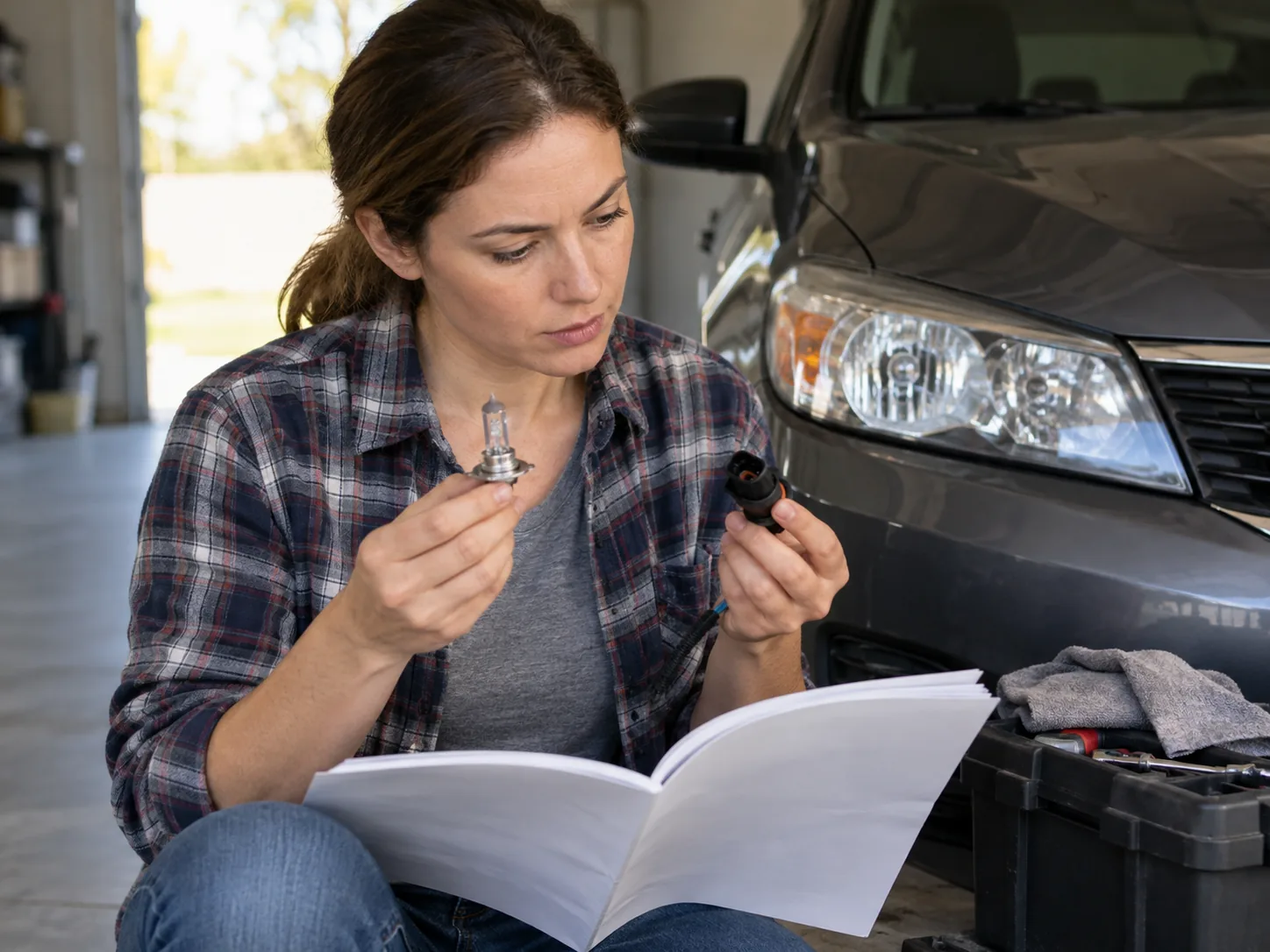

You are replacing one light, but your vehicle may use different bulb families for low beams, high beams, fog lamps, turn signals, brake lights, reverse lights, and interior fixtures. Trim and factory lighting packages can change the answer, and a replacement lamp assembly may not match the factory setup. A fitment lookup is a useful lead, not proof that the bulb fits the lamp in your car.
Before ordering, identify the exact lamp position, confirm its bulb marking against vehicle or assembly documentation, and resolve any mismatch.
Start with the exact lamp position
Record the vehicle year, make, model, trim, and market. Then name the light you are replacing as specifically as possible, such as “left low-beam headlight” rather than “front bulb.” Do not assume low beam, high beam, and fog lamp use the same bulb, or that one bulb number applies to every light on the vehicle.
If the vehicle has a factory LED or HID system, the serviceable part may be a module or complete assembly rather than a replaceable bulb. Check the owner's manual before trying to open the housing. Also note whether a previous owner may have changed the lamp assembly; the installed housing's label and part number can matter as much as the vehicle badge.
Use this lookup order
- Owner's manual or vehicle-specific service information. Find the bulb chart or replacement procedure for the exact trim and lamp position. Check footnotes for lighting packages or lamps that are not user-serviceable.
- Marking on the installed bulb. If the manual permits access and you can do it safely, switch the lights off, let the assembly cool, and follow the removal steps. Read the number printed on the bulb base. Do not force a retainer or pull on wiring.
- Label or part number on the installed lamp assembly. This is especially useful if the headlamp or tail lamp has been replaced. Confirm the label belongs to that exact assembly.
- Vehicle fitment lookup. Enter the full vehicle details and select the exact lamp position. Use the result as a cross-check, particularly on vehicles with multiple trims or replacement housings.
- Ask fitment support if sources disagree. Provide the vehicle details, lamp position, bulb marking, and clear photos of the connector and housing label. Ask them to explain the conflict before you order.
Do not average conflicting answers or pick whichever result appears most often online. A mismatch is a reason to pause and verify, not a reason to buy two bulbs and test-fit them.
Example: why the exact headlamp system matters
AUXITO’s chart for the 2013–2016 Hyundai Santa Fe lists H11B for the low beam with halogen headlamps and D3S for the low beam with HID headlamps. That is a useful illustration of why a vehicle name and model year alone may not settle the answer: the factory lighting system matters too. AUXITO says its chart applies to original-equipment assemblies and cautions that its data may not be fully accurate, so do not treat these codes as a fitment answer for another Santa Fe—or even for a modified vehicle. Check the exact manual, installed assembly, and bulb marking before ordering. See AUXITO’s Santa Fe chart.
This is also why a reputable bulb finder such as Sylvania’s Bulb Finder tells users to consult the owner’s manual for the bulb name and position specific to the vehicle.
When a lookup and the installed bulb disagree
Neither source automatically wins. The current bulb could be an earlier incorrect replacement; the fitment database could have mixed trim or production-date information; or the vehicle may have an aftermarket lamp assembly. Check these points:
- Did you choose the correct lamp position and enter the full trim, model year, and market?
- Does the manual identify a different lighting package or a sealed LED/HID assembly?
- Was the lamp assembly replaced? Look for its manufacturer label and part number.
- Does the installed bulb's base, connector, and marking match the vehicle or assembly documentation?
- Is there a conversion harness, adapter, or other modification that changes the setup?
Take photos of the bulb number, base and locating tabs, connector, and assembly label before reassembling. Compare them with the manual or send them to fitment support. Do not trim tabs, force a connector, or buy an adapter just to make two incompatible results appear to fit.
Bulb size is not the only compatibility check
| Check | What to confirm | Why it matters |
|---|---|---|
| Position and function | Low beam, high beam, fog, turn, brake, reverse, marker, or interior | One vehicle can use several different bulb families. |
| Lighting technology | Whether the assembly is designed for halogen, HID, LED, or a sealed module | A matching socket number alone does not establish that a technology conversion is suitable. |
| Base and connector | Part number, contact layout, tabs, retainer, and locking direction | A look-alike can fail to seat or make reliable contact. |
| Physical clearance | Rear cap, dust cover, wiring, fan, heat sink, and nearby parts | Some replacement bulbs are larger behind the base than the original. |
| Electrical and optical behavior | Specified voltage, polarity, warning behavior, beam pattern, and applicable local requirements | A bulb that turns on may still trigger errors or produce an unsuitable beam. |
For headlamps, do not choose an LED conversion from brightness claims or socket number alone. Check the exact assembly, rear-cover clearance, product documentation, beam performance, and rules where the vehicle is registered and driven. “Plug-and-play” is a seller description, not vehicle-specific approval.
Know when not to remove the bulb
Stop and ask a qualified parts professional or technician if the manual and physical parts still disagree, the housing is modified or damaged, the bulb label is missing, or access requires a procedure you do not understand. Do not open a sealed assembly or probe unfamiliar wiring to discover a size. Use the vehicle's service procedure, and do not handle a hot lamp.
Pre-order checklist
- I recorded the complete vehicle details and the exact lamp position.
- The owner's manual or vehicle-specific service information identifies that position's bulb or module.
- The installed bulb marking and housing label are consistent with the documentation, or I resolved the difference with support.
- I checked whether the housing is factory-original or a replacement assembly.
- The replacement's base, connector, retainer, and rear clearance match the actual lamp.
- If changing lighting technology, I checked its electrical, beam, and local-use requirements for this assembly.
If you cannot confirm the first three items, do not buy based on a generic “fits your car” label. Resolve fitment first; returning a wrong bulb does not establish that a different bulb is safe or appropriate.
Frequently asked questions
Where can I find my car's bulb size?
Start with the owner's manual's bulb chart for the exact lamp position. Cross-check the installed bulb marking and a vehicle lookup. If the answers conflict, verify the actual housing and ask support before ordering.
Can I trust the bulb already installed?
Use its marking as evidence, not final proof. It could be the wrong bulb or belong to a replacement lamp. Compare it with vehicle or assembly documentation.
Why do fitment tools show different bulb sizes?
They may use different trim, market, production-date, or lighting-package data. A replacement assembly can also change what is installed. Recheck the selected position and vehicle details, then ask the manufacturer or parts supplier to reconcile the results.
Can I replace a halogen bulb with LED if the number matches?
Not on that fact alone. Confirm the exact product and housing, physical clearance, electrical behavior, beam performance, and applicable local requirements. A matching base does not prove that a conversion is appropriate.
Next step: verify before comparing products
Find the bulb chart in your owner's manual and record the position-specific number. If you still need a database lookup, use the AUXITO vehicle bulb size guide as a helper, then confirm the result against the manual or installed part. AUXITO's own guidance also recommends checking those sources. This is a fitment lookup, not a recommendation that a particular AUXITO bulb fits your vehicle.
Affiliate disclosure: ModernCarGear may earn a commission if you use this link, at no additional cost to you. The link does not change the verification steps above.
Sources and claim scope
| Source | What it supports | Scope |
|---|---|---|
| AUXITO LED Bulb Finder | Vehicle lookup and its advice to check the stock bulb and consider aftermarket assemblies | Retailer tool; AUXITO notes its filter may not always be accurate or current. Not proof of a specific vehicle/SKU fit. |
| AUXITO Car Bulb Guide | Advice to check the vehicle manual or original bulb marking and contact support when uncertain | Retailer guidance only; it does not establish exact fitment for an individual car. |
| AUXITO product FAQ | Recommendation to confirm bulb size from the owner's manual or installed bulb before purchase | Brand purchasing guidance; no individual bulb recommendation is made here. |
| Vehicle owner's manual or service information | Position-specific bulb/module and safe access procedure | Must match the vehicle's exact year, trim, market, and actual assembly. |
| AUXITO Hyundai Santa Fe bulb chart | Lists different low-beam bulb types for the 2013–2016 Santa Fe according to halogen vs. HID headlamps | AUXITO chart limited to original-equipment assemblies; it warns that its data may not be fully accurate. Example only, not a fitment recommendation for the reader's vehicle. |
| Sylvania Bulb Finder | Advises checking the owner's manual for bulb name and position specific to the vehicle | General fitment guidance, not a validation of the Santa Fe chart above. |
Comments are closed!