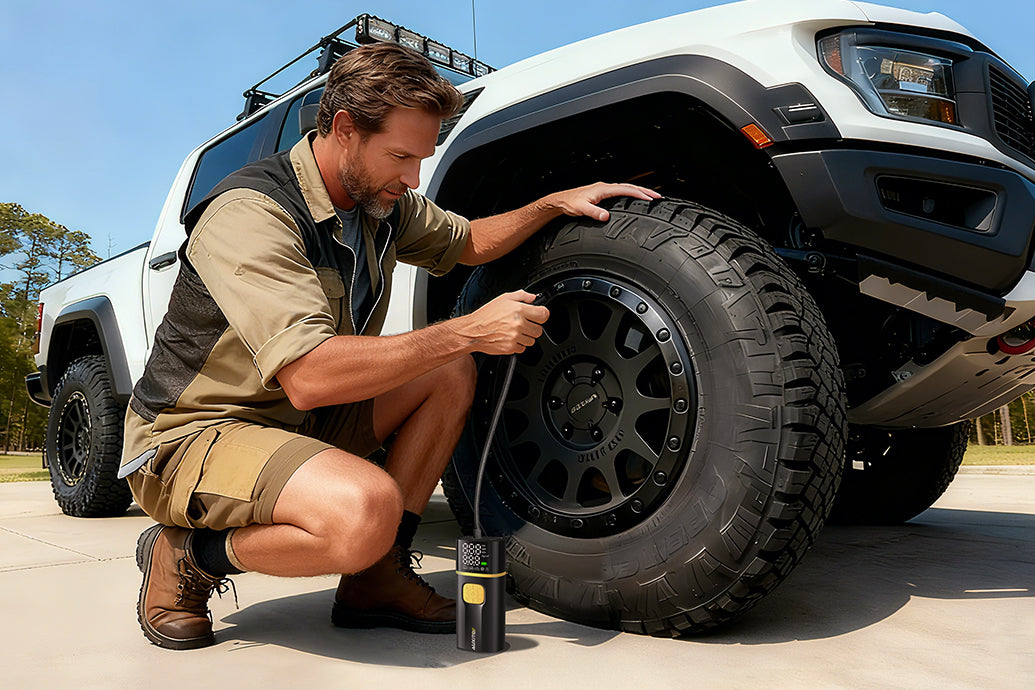

A tire inflator is useful for routine top-ups and some roadside pressure loss, but it cannot make a damaged tire safe. Choose one by the pressure and tire service you actually need, its power source, hose reach, gauge and stated cool-down limits—not by the largest PSI number on the box.
This is a research-based buying guide, not a hands-on comparison. We did not test the pumps discussed here. For correct pressure, use the vehicle’s tire placard or owner’s manual; the number molded on a tire sidewall is not the normal target pressure. Browse more practical equipment advice in our Car Accessories hub.
Quick decision: what kind of inflator fits your use?
- Occasional car top-ups or trunk emergency kit: compare a compact 12V or cordless unit. Check that the cable or hose reaches every tire and that its manual lists your intended tire type.
- Home use without a vehicle nearby: a rechargeable cordless model can be more convenient, but check charging time, battery storage guidance and whether the maker specifies a cool-down interval.
- Several tires, larger tires or repeated use: look for a published duty cycle and a fill-time test that identifies tire size and starting/ending pressure. A maximum-pressure rating alone does not show how quickly a pump works.
- Balls or inflatables as well as car tires: confirm the package includes the correct nozzle and a low-pressure mode. High maximum PSI does not mean the pump is suited to high-volume inflatables.
If you mainly need help after a dead battery, an inflator is not a jump starter. Our portable jump-starter safety guide covers that separate job.
Start with the tire and the pressure you need
Read the tire-pressure placard on the driver-side door area or check the owner’s manual. Note front, rear and spare pressures separately if they differ. NHTSA says the vehicle’s recommended pressure is a cold-tire target, typically checked after the vehicle has been parked for at least three hours. If you must check or add air while a tire is warm, do not bleed air just to match the cold reading; follow NHTSA’s warm-tire guidance and recheck when cold as soon as practical. The tire-sidewall number is a maximum, not necessarily the vehicle’s recommended setting. See NHTSA’s tire-safety guidance.
Before shopping, write down:
- The placard pressure for the tire you will inflate, including the spare if you intend to service it.
- The tire type and size from its sidewall, plus whether it is a standard car tire, light-truck tire, motorcycle tire or bicycle tire.
- How often you expect to inflate: an occasional small top-up is different from repeatedly filling several tires.
- Where you will use the pump and how far the power cord or hose must reach.
Do not choose a pump by applying a generic PSI target or a “1.5× headroom” rule. The vehicle maker’s pressure recommendation and the inflator’s instructions are the decision points. If the manual’s tire specification conflicts with a product listing, ask the vehicle or tire maker before using it.
Which specifications actually help compare inflators?
On a phone, swipe the comparison table horizontally to see every column.
| Specification | What it tells you | What it does not tell you |
|---|---|---|
| Maximum pressure | The upper pressure the maker says the pump can reach under stated conditions. | How fast it will inflate your tire or whether it is suitable for continuous use. |
| Airflow or fill-time claim | Potentially useful when the maker gives a comparable tire size and start/end PSI. | A fair speed comparison if test conditions differ or are not stated. |
| Duty cycle / rest period | How long the manufacturer permits operation before cooling. | A universal runtime. Follow the exact manual for the exact model. |
| Power source | Whether it uses a vehicle socket, battery clamps, rechargeable pack or household outlet. | That the power source is compatible with every vehicle outlet or battery setup. |
| Gauge and auto-stop | Convenience for setting a target and monitoring pressure. | That the displayed value is perfectly accurate. Recheck with a separate gauge if readings seem wrong. |
| Hose, cable and accessories | Reach and the valve adapters included for your intended use. | Compatibility with a valve or tire type not listed by the manufacturer. |
Compare like with like. For example, a claimed time to add a few PSI to a partly inflated tire cannot be compared directly with a claim to fill a fully deflated tire. Treat marketing phrases such as “fast” as unverified unless test conditions are clear.
Choose a power source for where you will use it
- Vehicle 12V outlet: convenient for a trunk kit, but check the vehicle manual for outlet limits and whether the engine must be running. Do not assume every socket supports every compressor.
- Rechargeable battery: easy to use away from the car. You must keep it charged and follow the maker’s temperature and storage guidance; a depleted pack is no help during a roadside stop.
- Battery-clamp or high-current design: may suit some larger compressors, but connection and operating instructions matter. If you are unsure about the vehicle’s electrical system, do not improvise a connection.
- AC-powered garage unit: useful where an outlet is available, but it is not a standalone roadside solution unless the manufacturer explicitly supports that setup.
Before buying, measure the route from the power source to the farthest tire. Include the spare if applicable. A short hose or cord can make a well-rated pump unusable for your vehicle.
When not to use an inflator as the fix
Stop and get professional help if a tire has a sidewall bulge, cut, exposed cords, a damaged wheel, a bead leak, or rapidly loses pressure. Adding air does not repair tire damage. NHTSA recommends having a tire professional check recurring pressure loss, unusual noise or vibration. Review NHTSA’s inspection and pressure guidance.
If a tire is flat or visibly damaged, do not keep driving on it to reach an air pump. Follow the vehicle’s roadside instructions, use a suitable spare if safe, or call roadside assistance. A portable inflator is for air-pressure service within the tire and pump makers’ directions, not for repairing a puncture or structural failure.
First-use checklist
- Read the inflator manual and inspect the hose, plug, battery and valve connector.
- Park safely, set the parking brake and keep the hose and cable clear of hot or moving parts.
- Set the target using the vehicle placard for that tire, not the sidewall maximum.
- Stay with the pump while it runs. Stop if the manual’s duty limit is reached, the unit overheats, smells unusual or behaves erratically.
- Verify the final pressure with a separate gauge when practical, reinstall the valve cap and check the other tires according to their placard values.
- Let the unit cool and recharge/store it as its manual directs.
Where AUXITO inflators fit in the comparison
AUXITO’s current tire-inflator catalog lists several models, including the A301 and A502. That is a manufacturer catalog, not an independent test or proof that a particular pump suits your tire. Check the live model page for its stated power source, pressure range, fill-time conditions, accessories, duty instructions, warranty and return terms before deciding.
Affiliate disclosure: We may earn a commission if you buy through this link, at no additional cost to you.
Once you know your tire type, target pressure and power-source preference, compare current AUXITO tire inflators. Confirm the exact model’s manual and listing before purchase.
Frequently asked questions
Should I inflate to the PSI printed on the tire sidewall?
Usually no. Use the vehicle’s tire placard or owner’s manual for the recommended cold pressure. The sidewall value is a maximum marking, not a universal target for the vehicle.
Does a 150-PSI inflator fill a tire faster than a 100-PSI model?
Not necessarily. Maximum pressure is not a speed rating. Compare airflow or fill time only when the manufacturer gives the same tire size and starting/ending pressure.
Can I leave an inflator running while I do something else?
No. Stay with it and follow its manual, even if it has auto-stop. Stop at the stated duty limit or if the unit overheats or shows a fault.
Can a tire inflator repair a puncture?
No. It adds air; it does not repair a puncture or damaged tire structure. Repeated pressure loss, sidewall damage or a damaged wheel needs a tire professional.
Sources and limitations
- NHTSA, Tire Safety — cold-pressure checks and the distinction between vehicle-recommended pressure and tire sidewall maximum.
- NHTSA, Summer Driving Tips — placard pressure and inspecting tires for visible damage.
- AUXITO tire inflator collection — confirms the brand currently lists a tire-inflator category; product specifications remain manufacturer claims and may change.